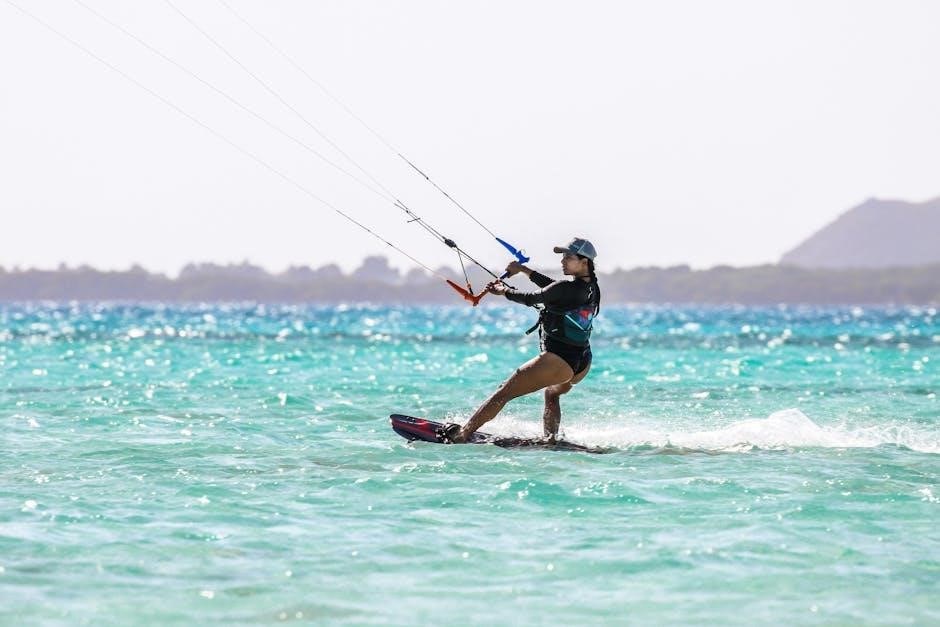
Kitesurfing Board Size Guide: A Comprehensive Overview (Updated 02/15/2026)
Navigating the world of kitesurfing requires selecting the correct board size, a crucial element for progression and enjoyment.
Experienced riders often utilize multiple boards—freeride, freestyle, wave, and light wind—to adapt to diverse conditions.
Beginners typically benefit from larger boards around 150cm, enhancing stability during initial learning phases and water starts.
Embarking on your kitesurfing journey begins with understanding kiteboard sizing, a fundamental aspect influencing control, performance, and overall enjoyment on the water. Selecting the appropriate board isn’t a one-size-fits-all scenario; it’s a nuanced process dependent on several key factors. These include your weight, skill level, prevailing wind conditions, and preferred riding style.
A common approach among seasoned kitesurfers is to maintain a quiver of boards, each tailored for specific conditions. This might include a smaller board optimized for kite loops and freeriding, a larger board with boots for freestyle maneuvers, a dedicated light-wind board for marginal conditions, and a specialized wave board for surf-inspired riding. However, for newcomers, starting with a more versatile size is generally recommended.
Generally, beginner boards are around 150cm, offering increased stability and making the initial learning curve less daunting. As skills develop, riders can then explore different sizes and shapes to refine their technique and expand their riding repertoire.
Why Kiteboard Size Matters
The size of your kiteboard profoundly impacts your kitesurfing experience, directly influencing stability, control, and the ability to progress. A board that’s too small can feel unstable and difficult to control, especially in lighter winds, hindering your ability to get up on the plane and maintain consistent riding. Conversely, a board that’s too large can feel sluggish and unresponsive, making it challenging to perform maneuvers and react quickly to changing conditions.
Correct sizing ensures optimal power distribution from the kite to the board, allowing for efficient upwind riding and smooth transitions. Larger boards provide greater surface area, enhancing stability and making water starts easier – a crucial benefit for beginners. Smaller boards, on the other hand, offer increased maneuverability and responsiveness, ideal for experienced riders seeking to push their limits.
Ultimately, selecting the right size allows you to maximize your time on the water and enjoy the sport to its fullest potential.
Factors Influencing Kiteboard Size Choice
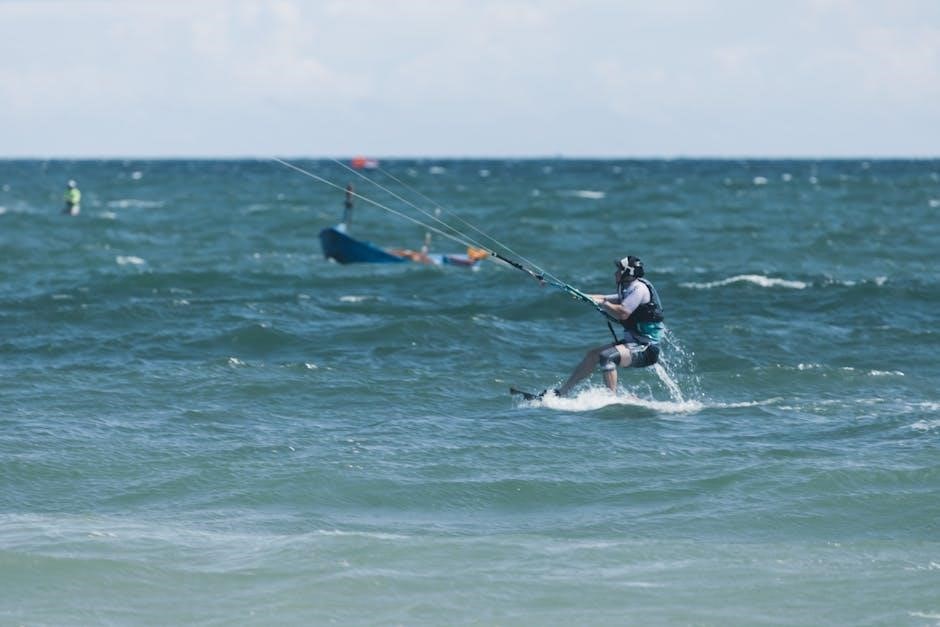
Several key factors dictate the ideal kiteboard size for each rider, extending beyond just weight. Wind conditions are paramount; lighter winds necessitate larger boards to generate sufficient power for lift and maintain control, while stronger winds demand smaller boards for enhanced responsiveness and to prevent overpowering.
Rider weight is a primary consideration, with heavier riders requiring larger boards for adequate floatation and stability. Skill level also plays a crucial role – beginners benefit from larger, more stable boards, while advanced riders often prefer smaller, more maneuverable options;
Riding style significantly impacts board selection. Freestyle riders often favor boards optimized for pop and responsiveness, whereas wave riders prioritize boards designed for carving and control. Finally, personal preference and comfort levels should always be factored into the decision-making process.
Understanding Kiteboard Dimensions
Kiteboard dimensions—length, width, and rocker— profoundly influence performance characteristics. These elements dictate stability, riding style, and overall responsiveness on the water, impacting control.
Length and its Impact on Riding Style
Kiteboard length significantly shapes the riding experience, influencing both speed and maneuverability. Longer boards generally offer enhanced upwind performance and stability, making them ideal for freeriding and covering distance efficiently. They track well in choppy conditions and provide a smoother ride, particularly beneficial for beginners or those prioritizing comfort.
Conversely, shorter boards excel in freestyle and wave riding, where quick turning and responsiveness are paramount. Their reduced length allows for tighter rotations, easier transitions, and more playful handling. Shorter boards are less stable at high speeds and require more rider input to maintain control, demanding a higher skill level. The choice between length depends heavily on your preferred riding style and experience.
A longer board provides a forgiving platform, while a shorter board unlocks more aggressive and technical maneuvers. Considering these trade-offs is crucial when selecting the appropriate length for your needs.
Width and its Effect on Stability
A kiteboard’s width is a key determinant of its stability and control, particularly impacting how easily a rider can recover from off-balance situations. Wider boards offer a larger surface area, translating to increased stability, especially at lower speeds or in choppy water conditions. This makes them exceptionally well-suited for beginners learning to find their balance and master water starts.
Narrower boards, conversely, provide less stability but offer enhanced edge control and responsiveness. This allows for quicker transitions and more precise maneuvers, favored by experienced riders engaged in freestyle or wave riding. The reduced width also minimizes drag, contributing to higher speeds.
Finding the right width involves balancing stability with performance. Wider boards are more forgiving, while narrower boards reward skilled riders with greater control and agility. Consider your skill level and intended riding style when evaluating board width.
Rocker and its Role in Performance
Rocker, the curvature of a kiteboard from tip to tail, profoundly influences its performance characteristics. A board with significant rocker—a pronounced curve—will excel in choppy conditions and wave riding, offering a smoother ride and easier turning. This curvature breaks up the water’s surface, reducing spray and improving control in uneven waters.
Boards with flatter rocker lines prioritize speed and efficiency, ideal for freeriding and flatwater freestyle. The reduced curvature minimizes drag, allowing riders to achieve higher speeds with less effort. However, they can be more challenging to control in rough conditions.
The amount of rocker also affects a board’s ability to pop for jumps. More rocker generally translates to a softer landing, while less rocker provides a more direct and powerful pop. Understanding rocker profiles is crucial for selecting a board that complements your riding style and preferred conditions.
Kiteboard Size Charts by Rider Weight
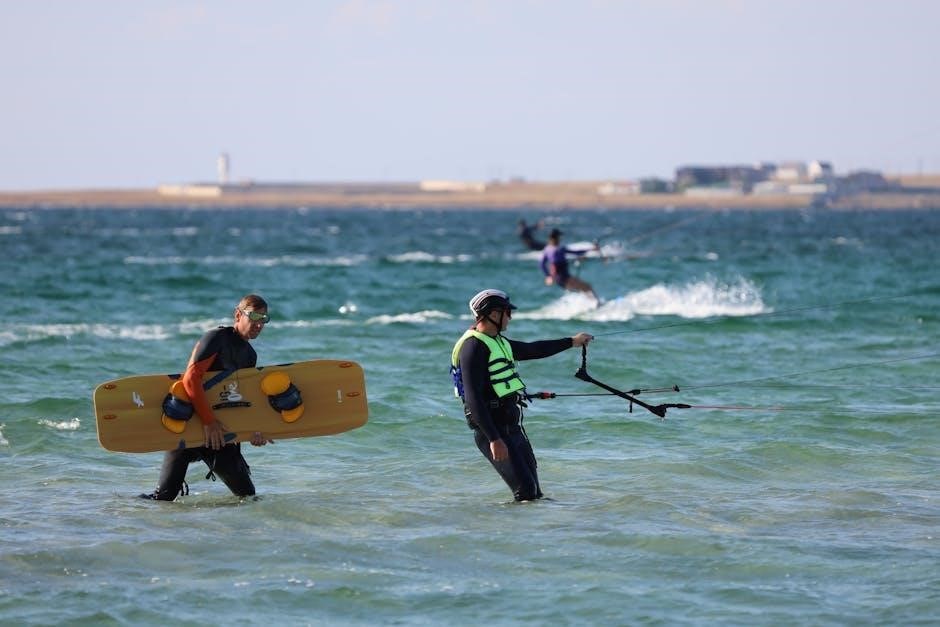
Determining the ideal kiteboard size often begins with rider weight, serving as a foundational guideline for selecting appropriate board dimensions and ensuring optimal performance on the water.
Beginner Rider Weight & Board Size Recommendations
For novice kitesurfers, prioritizing stability and ease of water starts is paramount. Generally, riders under 150lbs (68kg) should consider boards in the 145cm-155cm range. Individuals weighing between 150lbs and 180lbs (68kg-82kg) will find boards between 150cm and 160cm most suitable. Heavier riders, exceeding 180lbs (82kg), should opt for boards 155cm and larger.
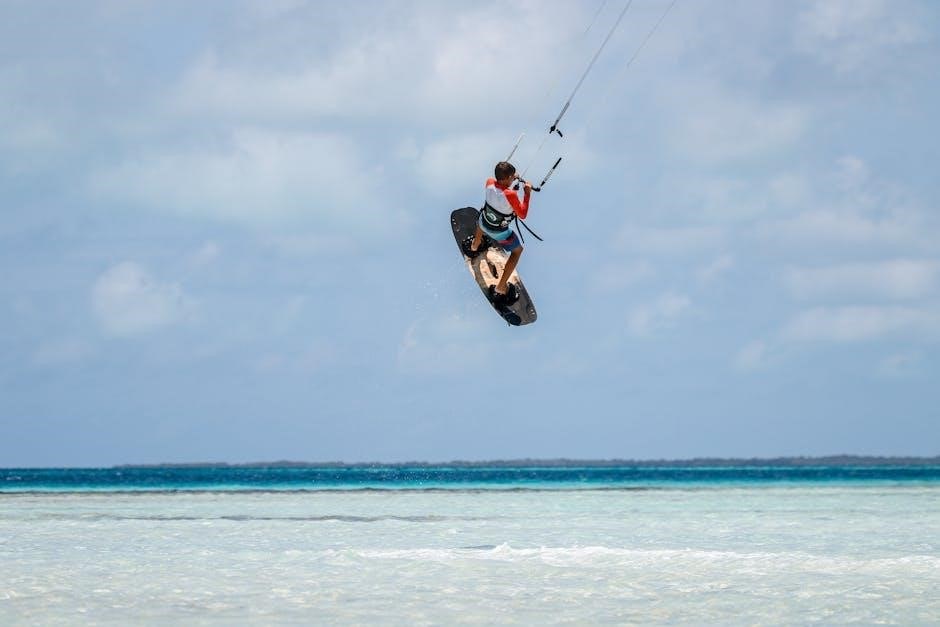
Larger boards provide a greater surface area, significantly enhancing stability and making it easier to get up on the board. This is especially beneficial during the initial learning curve when mastering water starts and board control. A board around 150cm is frequently recommended for teaching and beginner lessons, as it simplifies the process. As skills develop and water starts become consistent, riders can gradually transition to smaller, more maneuverable boards.
Remember these are starting points; individual skill level and wind conditions also play a role; Prioritize a board that feels comfortable and allows for controlled progression.
Intermediate Rider Weight & Board Size Recommendations
Intermediate kitesurfers, now consistently water starting and riding upwind, can begin refining their board selection. Riders under 150lbs (68kg) often thrive on boards ranging from 135cm to 145cm, offering increased maneuverability without sacrificing too much stability. Those between 150lbs and 180lbs (68kg-82kg) should explore boards in the 140cm-155cm range.
Heavier riders, exceeding 180lbs (82kg), will generally find boards between 150cm and 165cm ideal. This stage focuses on progressing beyond basic riding, incorporating carving turns and exploring different riding styles. A slightly smaller board allows for quicker transitions and more responsive handling.
Experimentation is key; consider your preferred riding style. Freeride-focused riders may prefer slightly larger boards for comfort and upwind ability, while those leaning towards freestyle might opt for smaller, more agile boards.
Advanced Rider Weight & Board Size Recommendations
Advanced kitesurfers possess refined skills and a clear understanding of their preferred riding style, allowing for highly personalized board choices. Riders under 150lbs (68kg) frequently utilize boards from 130cm to 140cm, prioritizing responsiveness for technical tricks and wave riding. Those between 150lbs and 180lbs (68kg-82kg) typically ride boards in the 135cm-150cm range.
Heavier riders, over 180lbs (82kg), often benefit from boards between 145cm and 160cm, maintaining control and power during aggressive maneuvers; Advanced riders often own multiple boards tailored to specific conditions – a dedicated freestyle board, a wave board, and a light-wind option.
Boot versus strap configuration significantly impacts size selection. Boots generally require a slightly larger board for comfortable control. Ultimately, advanced riders fine-tune their choices based on personal preference and evolving skillsets.
Kiteboard Size Based on Wind Conditions
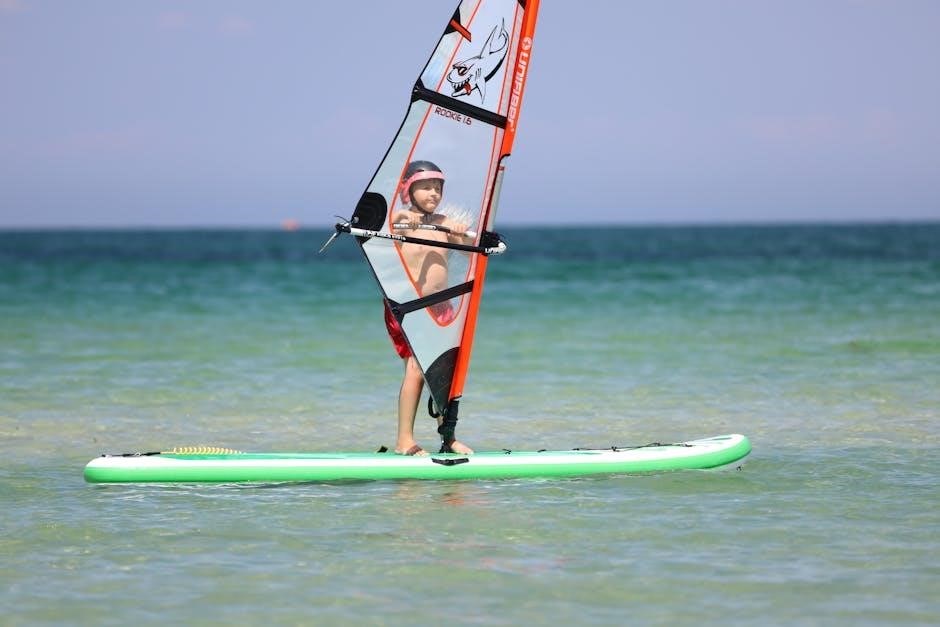
Wind strength dictates optimal board size; lighter winds necessitate larger boards for planing, while stronger winds demand smaller boards for control and maneuverability.
Adapting your board ensures a safe and enjoyable experience.
Light Wind Kiteboard Sizes (Below 12 knots)
When the wind barely whispers, maximizing surface area is paramount. For conditions below 12 knots, kitesurfers turn to larger kiteboards, typically ranging from 165cm to 178cm, and even exceeding 180cm for the lightest breezes. These boards are designed to plane efficiently with minimal wind power, allowing riders to stay up and riding when others are struggling.
The key characteristic of light wind boards is their increased width, often exceeding 45cm, further enhancing planing capabilities. Many riders dedicated to light wind performance will invest in a dedicated “light wind” board, often featuring a flatter rocker profile to maximize contact with the water. These boards prioritize early planing and upwind performance over aggressive carving or freestyle maneuvers. Choosing the right size depends on rider weight; heavier riders will require larger boards even within this range.
Medium Wind Kiteboard Sizes (12-20 knots)
The 12-20 knot wind range represents the sweet spot for many kitesurfers, offering versatility for various riding styles. Within this range, board sizes typically fall between 138cm and 155cm, providing a balance of stability, control, and maneuverability. This is often considered the “all-around” size for intermediate riders, suitable for freeriding, light freestyle, and even introductory wave riding.
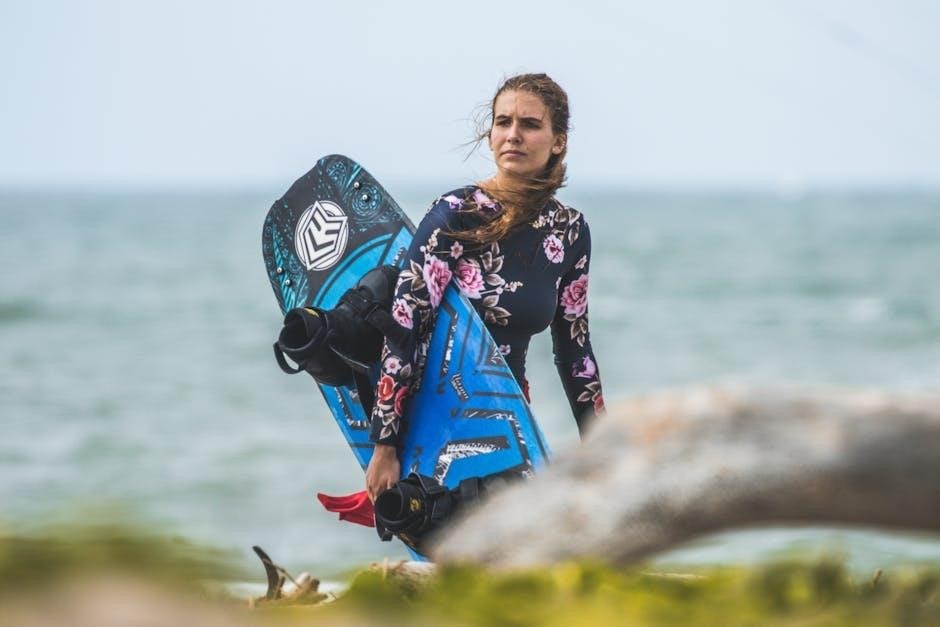
Rider weight plays a significant role; lighter riders will gravitate towards the smaller end of the spectrum (138-145cm), while heavier riders will prefer boards in the 148-155cm range. Boards in this category generally feature a moderate rocker profile, offering a blend of upwind performance and carving ability. Many riders will own a single board within this size range to cover the majority of their riding sessions, making it a crucial choice for overall progression.
Strong Wind Kiteboard Sizes (20+ knots)
When the wind consistently exceeds 20 knots, transitioning to a smaller kiteboard becomes essential for maintaining control and preventing overpowered situations. Board sizes in this range typically fall between 130cm and 145cm, prioritizing responsiveness and edge control. These boards often feature a flatter rocker profile and increased stiffness, allowing for precise steering and efficient power transfer.
Experienced riders often utilize these smaller boards for aggressive freestyle maneuvers, kite loops, and high-performance wave riding. Lighter riders may even opt for boards as small as 125cm in extremely strong winds. The reduced surface area minimizes the board’s resistance against the wind, enabling quicker turns and more predictable handling. Selecting the appropriate size ensures a safe and exhilarating experience in challenging conditions.
Kiteboard Types and Corresponding Sizes
Different kitesurfing disciplines demand specific board characteristics and sizes; freeride boards offer versatility, freestyle boards prioritize pop, wave boards focus on maneuverability, and light-wind boards maximize surface area.
Freeride Kiteboard Sizes
Freeride kiteboards are the all-around workhorses of the sport, designed for comfortable cruising, long rides, and accessible progression. They strike a balance between stability, control, and responsiveness, making them ideal for a wide range of skill levels and wind conditions. Generally, freeride boards fall within the 138cm to 165cm range, with the specific size depending heavily on rider weight and preferred riding style.
Lighter riders (under 70kg) will typically gravitate towards the smaller end of the spectrum (138cm-145cm), while heavier riders (over 90kg) will benefit from the added stability and planning power of larger boards (155cm-165cm). Intermediate weights (70kg-90kg) have a broader range to choose from, often opting for boards around 145cm-155cm. A slightly wider board (over 40cm) will enhance stability, particularly for beginners or those riding in choppy conditions. Freeride boards often feature a moderate rocker line, providing a good blend of upwind performance and smooth riding.
Freestyle Kiteboard Sizes
Freestyle kiteboards are engineered for performance, prioritizing pop, flex, and responsiveness for executing technical tricks. These boards typically feature a more aggressive rocker line and a thinner profile compared to freeride boards, allowing for greater flexibility and explosive takeoffs. Freestyle board sizes generally range from 133cm to 145cm, with a tendency towards the smaller end of the spectrum for increased maneuverability.
Riders seeking maximum pop and quick transitions often prefer boards around 135cm-140cm. Heavier riders or those prioritizing stability while learning new tricks may opt for slightly larger boards (140cm-145cm). A narrower width (under 40cm) enhances edge pressure and facilitates quicker rotations. Many freestyle boards are designed to be ridden with boots, which further enhances control and responsiveness; The choice also depends on riding style; some prefer a softer flex for easier pressing, while others favor a stiffer board for more precise landings.
Wave Kiteboard Sizes
Wave kiteboards are specifically designed for riding and performing maneuvers on ocean waves, demanding a unique blend of flexibility, control, and responsiveness. Unlike freestyle boards, wave boards prioritize carving ability and smooth transitions between turns. They typically feature a more pronounced rocker line, allowing for easier turning and rail-to-rail transitions, and often incorporate features like a five-fin setup for enhanced grip and drive.
Wave board sizes generally range from 5’2” to 6’0” (approximately 157cm to 183cm), with the specific size depending on rider weight, skill level, and wave conditions. Smaller riders or those riding smaller waves may prefer boards around 5’4” to 5’8”, while larger riders or those tackling bigger waves will benefit from boards in the 5’8” to 6’0” range. A wider outline provides stability and allows for easier planing, while a thinner profile enhances responsiveness. Many wave riders prefer boards without footstraps for maximum freedom of movement.
Light Wind Kiteboard Sizes
Light wind kitesurfing presents unique challenges, requiring boards designed to maximize planing and upwind performance in minimal wind conditions. These boards are characterized by their larger surface area, wider outline, and flatter rocker, all contributing to increased lift and reduced drag. The goal is to get you up and riding with a smaller kite, preserving control and responsiveness.
Light wind kiteboard sizes typically start around 165cm and can extend to 175cm or even larger for exceptionally light conditions. Riders often choose a dedicated light wind board to supplement their standard quiver. A wider board (40cm+) provides greater stability and easier water starts, while the flatter rocker allows for quicker planing speeds. Many light wind boards also feature a wood core construction for added stiffness and responsiveness. Selecting the right size depends on rider weight and the typical wind speeds in your riding location.
Beginner Kiteboard Size Recommendations
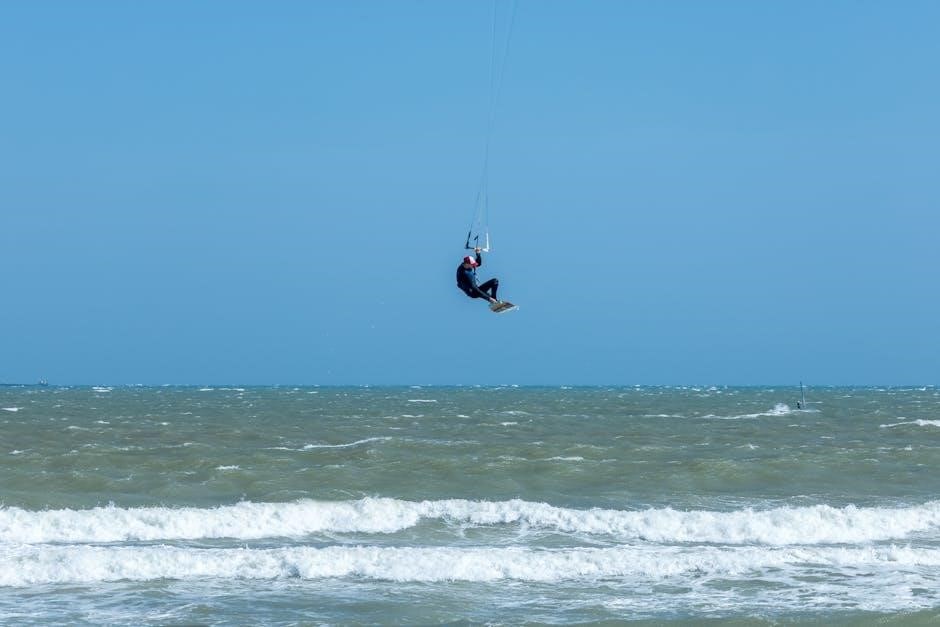
For initial learning, a 150cm+ kiteboard is generally recommended, offering enhanced stability and making water starts significantly easier for novice kitesurfers.
The 150cm+ Range for Initial Learning
Embarking on your kitesurfing journey necessitates a board that prioritizes stability and ease of use, and that’s where the 150cm+ range truly shines. These larger boards provide a substantial surface area, directly translating to increased floatation and a more forgiving ride – critical elements when mastering the fundamentals.
The larger surface area isn’t merely about staying afloat; it dramatically simplifies the water start process. Getting up on the board requires less power and technique, allowing beginners to focus on body positioning and kite control. This reduced demand for precise execution builds confidence and accelerates learning.
Furthermore, a larger board offers greater tolerance for errors in technique. Small imbalances or incorrect movements are less likely to result in a fall, fostering a more positive and less frustrating learning experience. As skills develop and water starts become consistent, transitioning to a smaller, more performance-oriented board becomes a natural progression.
Benefits of Larger Boards for New Riders
For those new to the exhilarating world of kitesurfing, opting for a larger board unlocks a wealth of advantages, significantly streamlining the learning curve and maximizing early success. The primary benefit lies in enhanced stability; a wider platform minimizes wobble and provides a more planted feel, crucial for building confidence.
Larger boards require less rider input to maintain control, reducing fatigue and allowing beginners to concentrate on mastering kite skills. This is particularly important during the initial stages, where coordinating kite movements with board control can be challenging. The increased surface area also translates to earlier planing, meaning less time spent struggling to get up to speed.
Moreover, larger boards offer a more forgiving ride, absorbing chop and minimizing the impact of minor errors. This reduces the likelihood of falls and promotes a more enjoyable learning experience, fostering a quicker path to independent riding. They truly are a stepping stone to progression!
Advanced Rider Considerations
Experienced kitesurfers often curate a board quiver, tailoring equipment to specific conditions and riding styles; Boot or strap configurations, alongside board size, impact performance and control.
Using Multiple Boards for Versatility
For the progressing kitesurfer, investing in a quiver of boards unlocks a new dimension of riding possibilities. As skill levels advance, relying on a single board becomes limiting, hindering performance across varying wind strengths and wave conditions. Elite Watersports highlights the benefit of having dedicated boards for specific disciplines – a smaller board optimized for kite loops and freeride, a larger board with boots for freestyle maneuvers, a flat, expansive board for light wind sessions, and a specialized board designed for carving waves.
This approach allows riders to maximize efficiency and enjoyment, ensuring they’re always equipped with the ideal tool for the task at hand. A versatile quiver eliminates compromises, enabling precise control and responsiveness. Instead of forcing a single board to perform in all scenarios, riders can select the board that best complements the wind, water state, and desired riding style, ultimately accelerating progression and expanding their kitesurfing horizons.
Kite Loop Specific Board Sizes
When prioritizing kite loops, board size plays a critical role in achieving controlled and powerful rotations. Riders seeking to consistently land kite loops often opt for smaller, more responsive boards. Elite Watersports emphasizes utilizing a dedicated, smaller foot strap board specifically for this purpose. This reduction in surface area minimizes swing and allows for quicker edge changes, essential for initiating and completing loops with precision.
Generally, boards in the 130cm to 138cm range are favored for kite loop performance, offering a balance between control and maneuverability. Larger boards can feel sluggish and less predictable during loops, increasing the risk of losing control. The smaller size facilitates a tighter turning radius and enables riders to maintain a more aggressive edge throughout the loop, resulting in a cleaner and more satisfying execution. Proper foot strap adjustment is also crucial for secure footing during these dynamic maneuvers.
Boot vs. Strap Configurations and Size Adjustments
The choice between boots and straps significantly impacts board feel and performance, influencing optimal size selection. Riders utilizing boots generally prefer slightly larger boards compared to those riding with straps. Boots provide increased support and control, but also add bulk, requiring a wider platform for comfortable foot placement and efficient power transfer.
Conversely, strap configurations allow for a more direct connection to the board, enhancing responsiveness and feel. This direct connection often allows riders to downsize their board slightly. Adjusting strap placement is also crucial; a wider stance generally enhances stability, while a narrower stance promotes agility. Experimentation is key to finding the optimal setup for individual riding style and preferences. Fine-tuning strap angles and positioning can dramatically alter board control and responsiveness, maximizing performance in various conditions.